HAI101 · LSE · 6 November 2026

Uncovering the
general structure
of model transfer
between sciences

Max Noichl

Introduction

  • Doctoral candidate at Utrecht University in theoretical philosophy.
  • Data-driven philosophy, philosophy with AI, complex collective cognition, philosophy of science.
  • To follow along: maxnoichl.eu/talk
  • Today: Uncovering the general structure of model transfer between sciences

The plan
  1. IModel transfer
  2. IIInterlude: OA Atlas
  3. IIIApplications
  4. IVGeneralizing the approach
  5. VThe structure of model transfer

Part I
Model transfer

Model transfer

  • A model gets developed for one domain, and becomes applicable to very different others.
  • Some examples: Lotka–Volterra Model, Kuramoto Model, Hopfield Model, NK-Model
  • Real transfer, convergence, adaptation?
  • Philosophically interesting:
    • (Computational) Reorganization of Science?
    • Scientific Creativity (and: predicting science)
    • Pragmatism or metaphysics?

Part II · Interlude
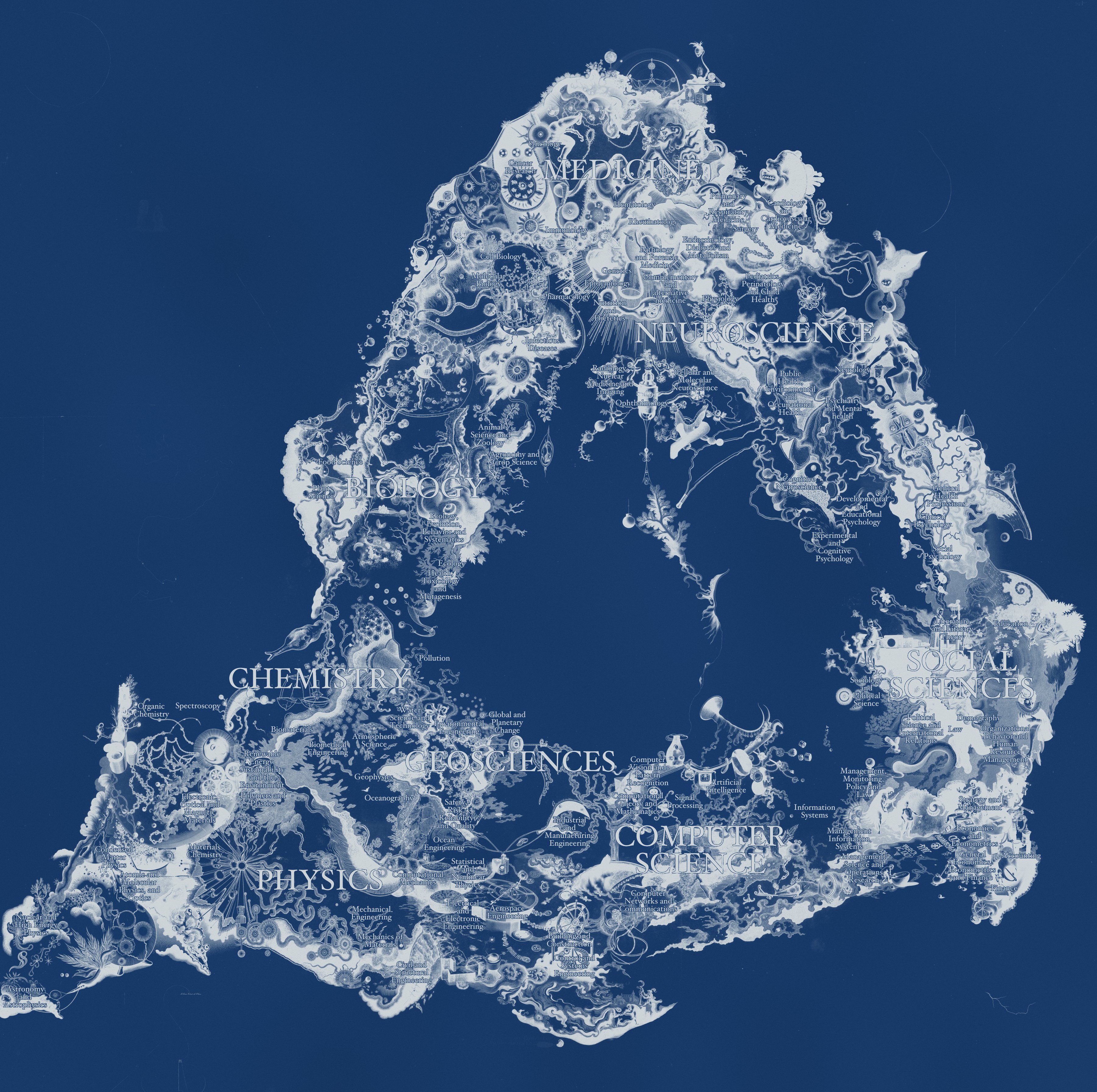
OA Atlas

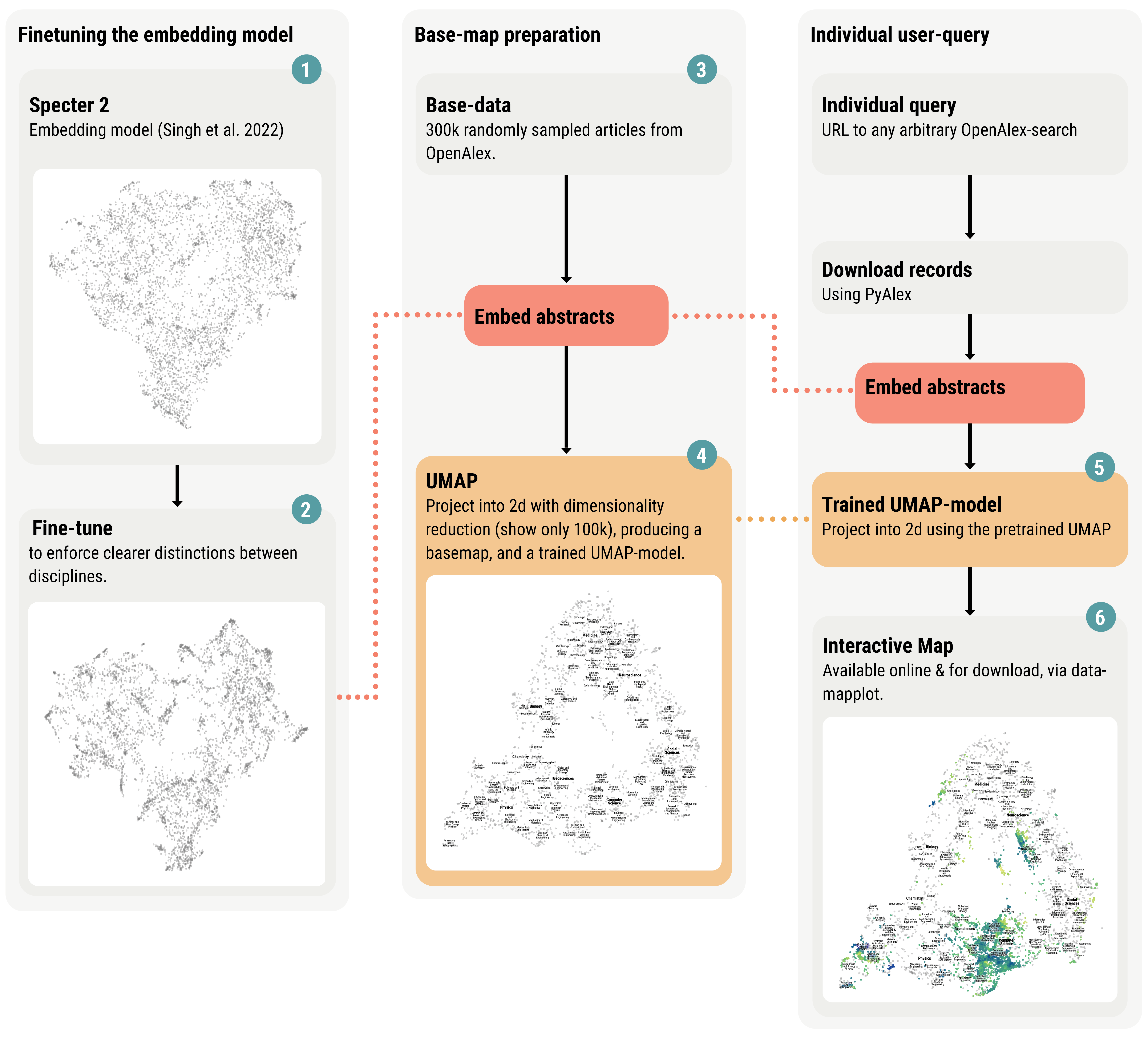
OA Atlas The workflow.
Priem et al. (2022) Singh et al. (2023) McInnes et al. (2018) De Bruin ([2022] 2023)
Now, why is this useful for PhilSci?

  • Philosophers need to be acquainted with science:
    • Training, interviews, case studies, etc.
  • Problem: generalization, validation?
    • Interactive, large-scale computational analysis.

Part III
Applications

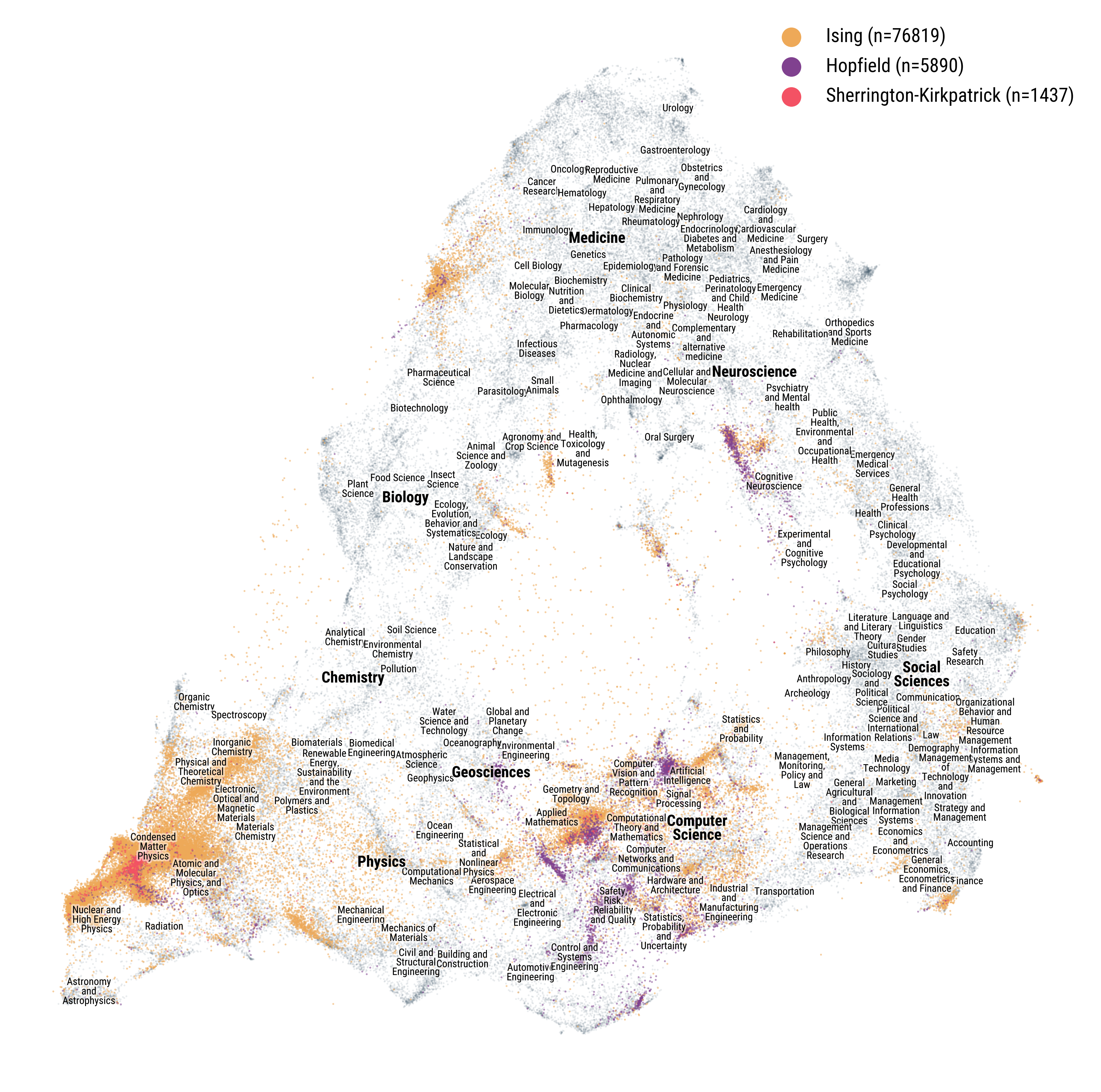
Model templates Debates about model transfer in science, model templates as a structuring principle orthogonal to disciplines.
Humphreys (2004) Knuuttila and Loettgers (2023)
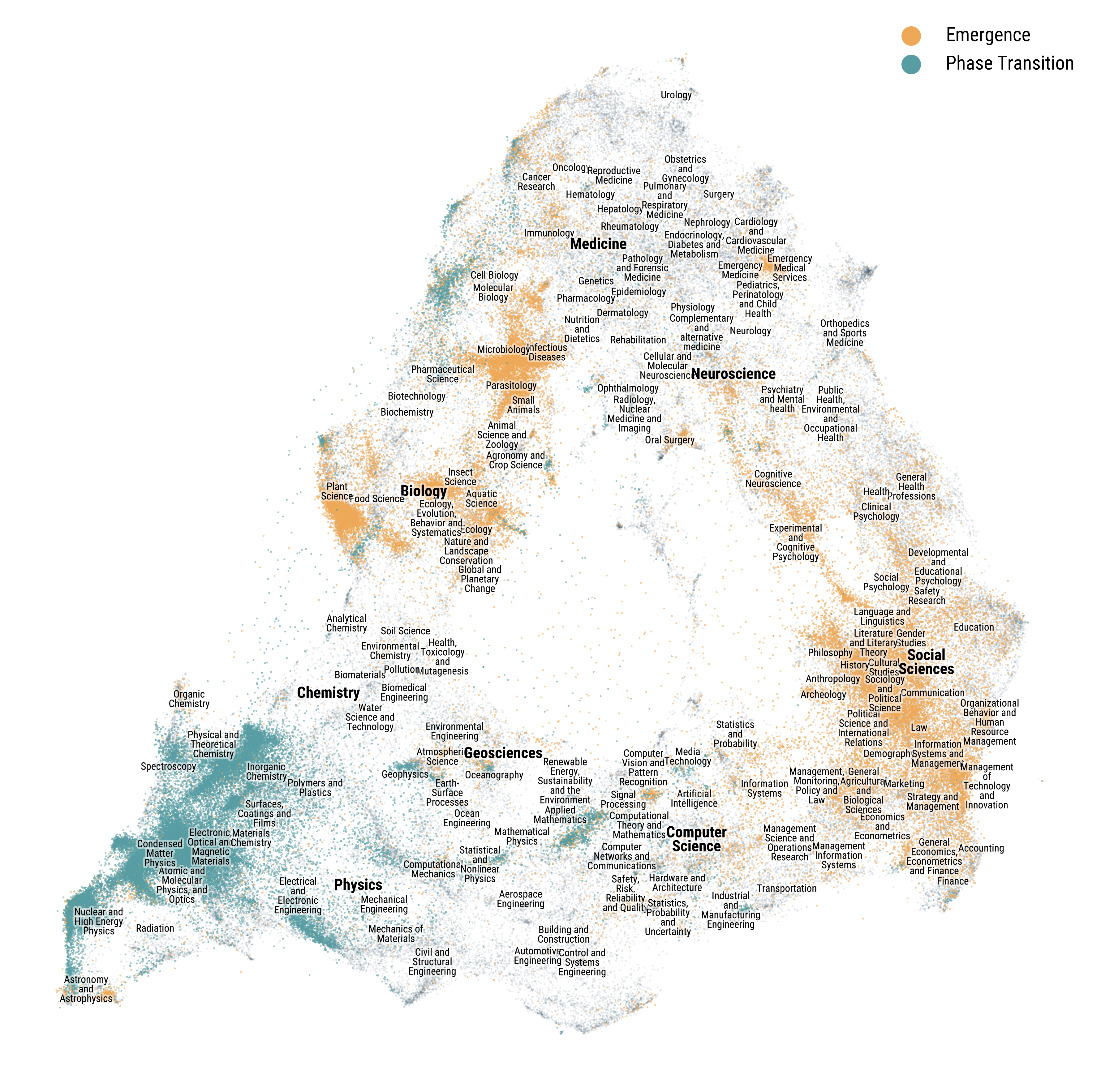
Concepts Distribution of concepts over large, interdisciplinary samples.
Malaterre et al. (2020) Zichert and Wüthrich (2024)
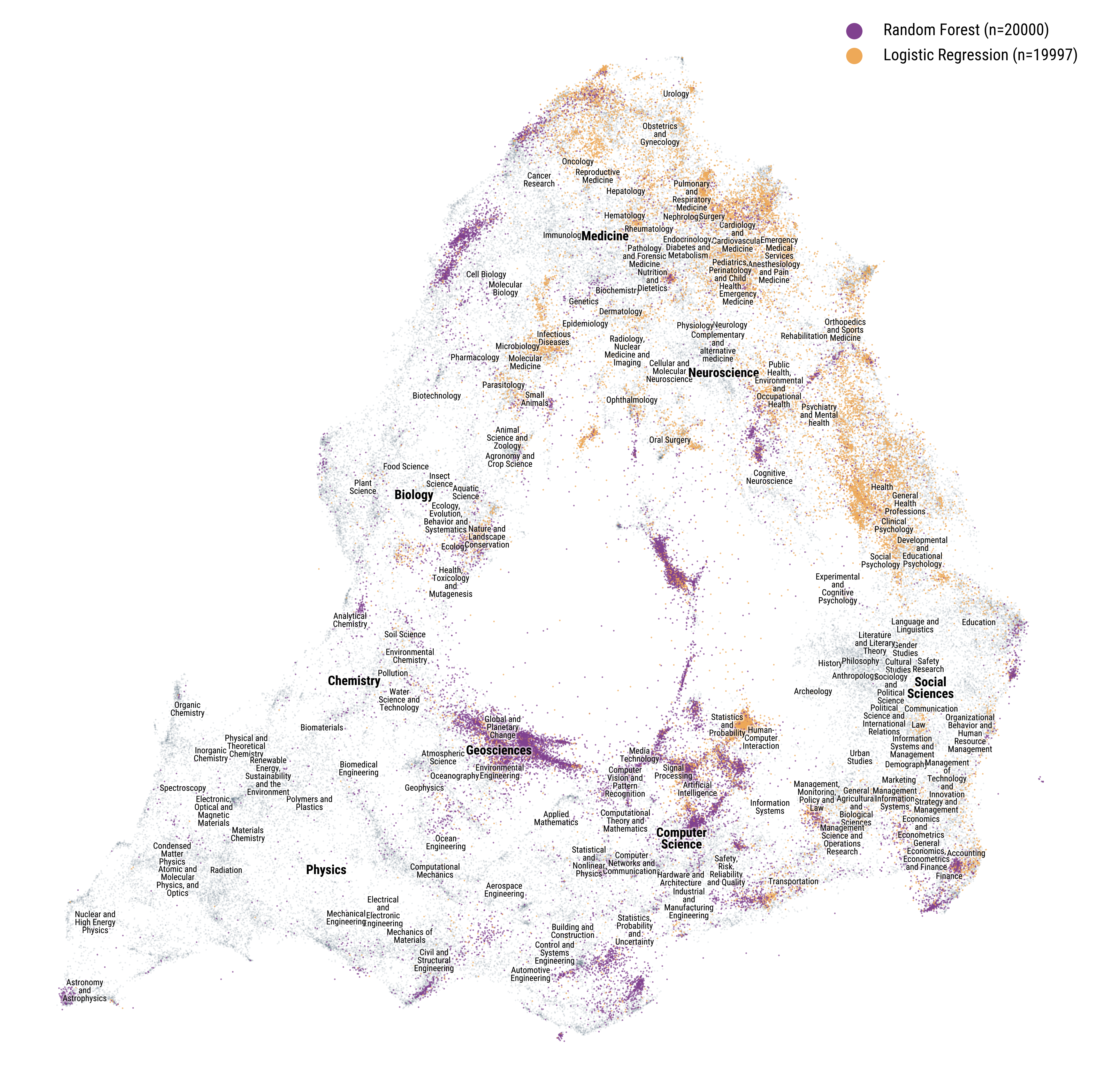
Methods Relevant for debates on machine learning in science vs. classical statistics, theory-free science.
Breiman (2001) Bzdok et al. (2018) Andrews (2023)
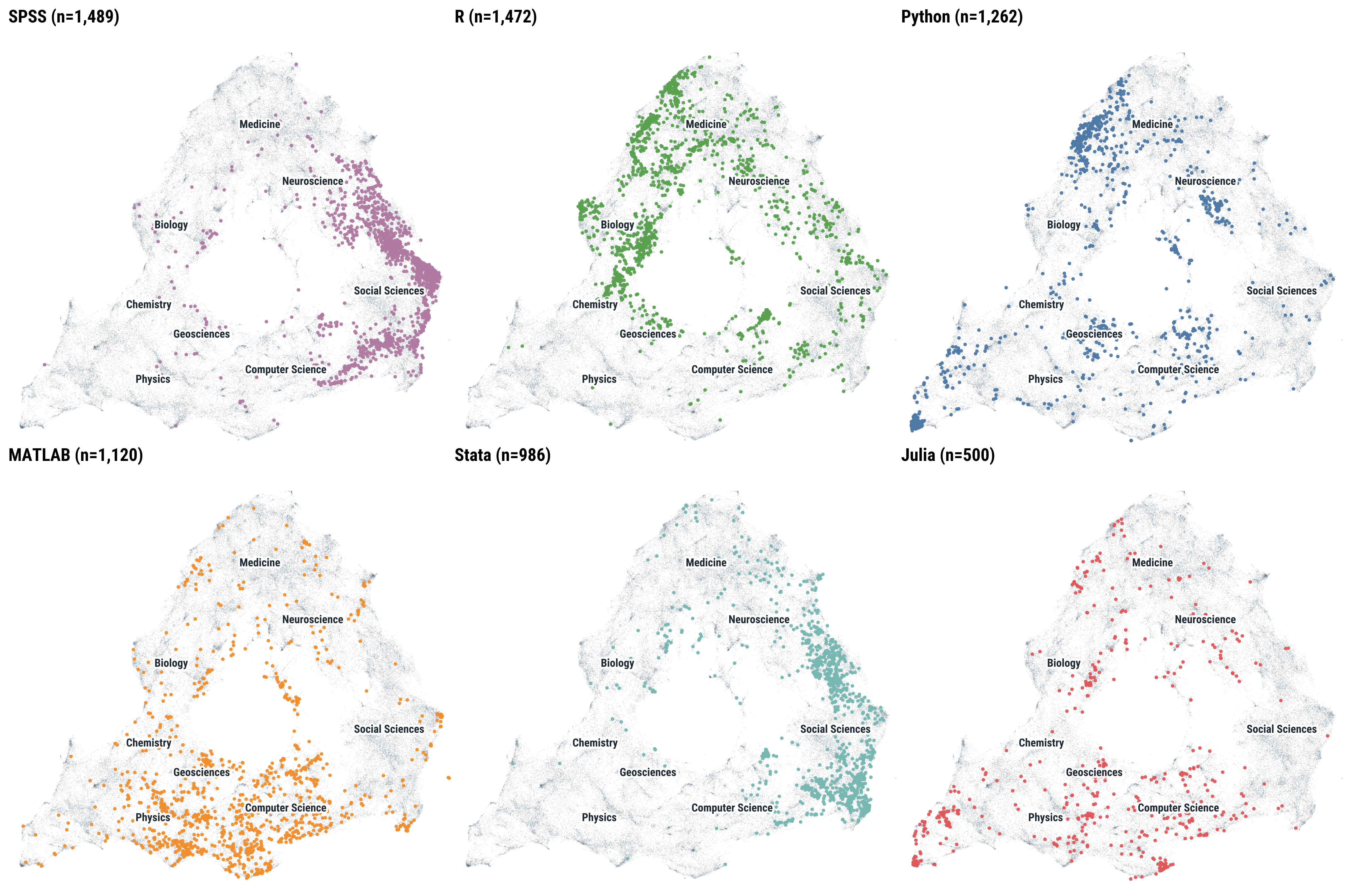
Computational substrates Distribution of programming and statistical languages across scientific fields.
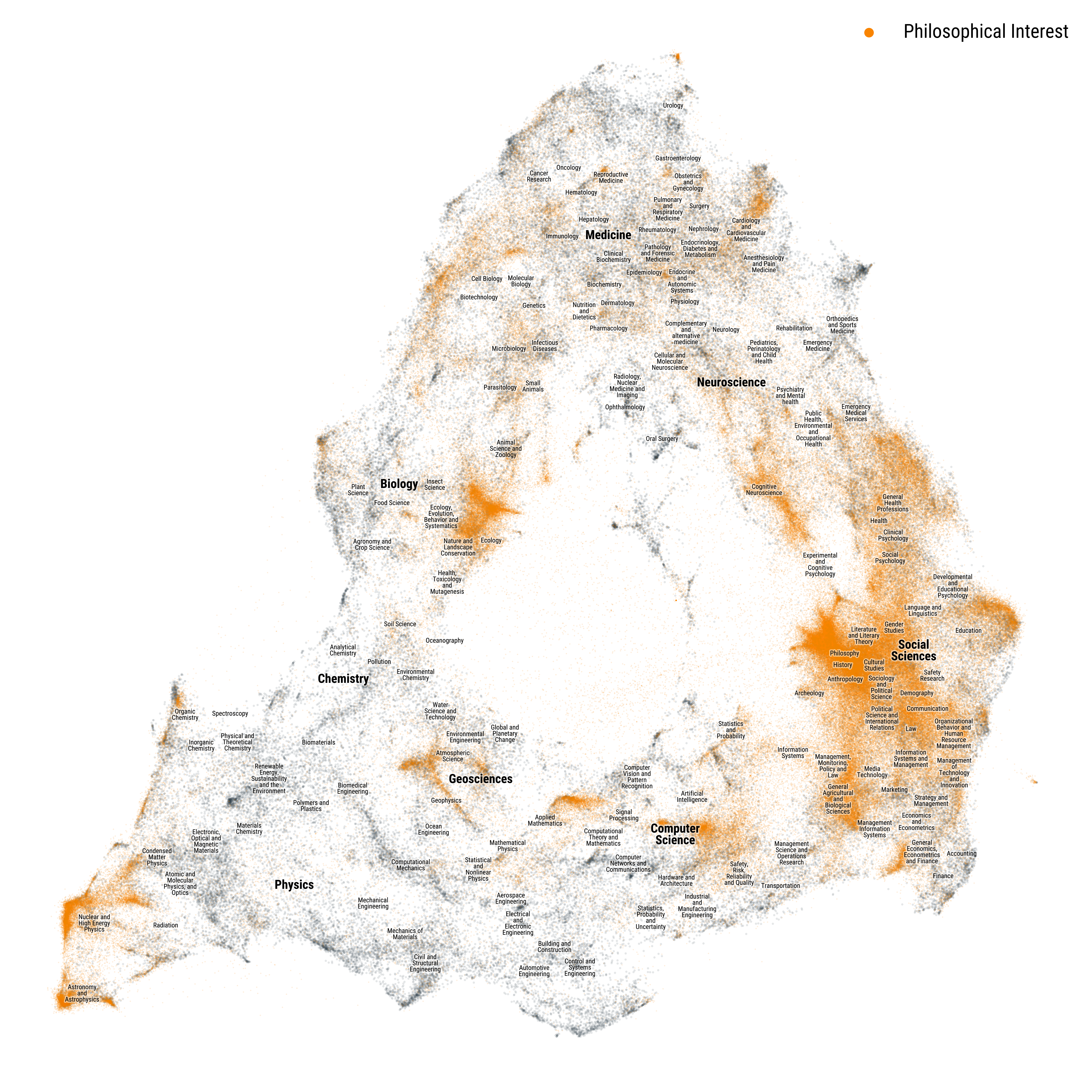
Attention of HPS 500k sources of the history and philosophy of science literature.
Weingart (2015)

Journal Number of Papers
Isis 22858
Technology and Culture 13140
Journal of Philosophy 12806
Synthese 10484
Philosophy of Science 7432
British Journal for the History of Science 5810
British Journal for the Philosophy of Science 4380
Journal for the History of Astronomy 3194
Studies in History and Philosophy of Science 2798
Annals of Science 2742
Social Studies of Science 2176
History of Science 1511
Studies in History and Philosophy of Modern Physics 1227
Archive for History of Exact Sciences 1088
Osiris 960
History and Philosophy of the Life Sciences 914
Historical Studies in the Natural Sciences 602

Part IV
Generalizing
the approach

Identifying Models

  • Search on OpenAlex (OA) for model, equation, process, map, automaton.
  • Retrieve 1M random records.
  • Use gpt-6.1 Sol to filter raw strings: “SIR model” vs. “mouse model”
  • Arrange by shortest path on substring similarity, merge in batches & filter.
  • 3,380 candidate models. Search canonical names on OA.
  • Keep 1,338 models with more than 1,000 mentions.

Researching Models

  • gpt-6.1 Sol with web access on high reasoning refines OA queries and checks them against common problems.
    • “SIR model” or “Susceptible–Infected–Recovered model” or “…”
  • Download 5,000 random records per model, total 5.63M abstracts.
  • Embed and project onto a basemap (Qwen3-Embedding-0.6B)

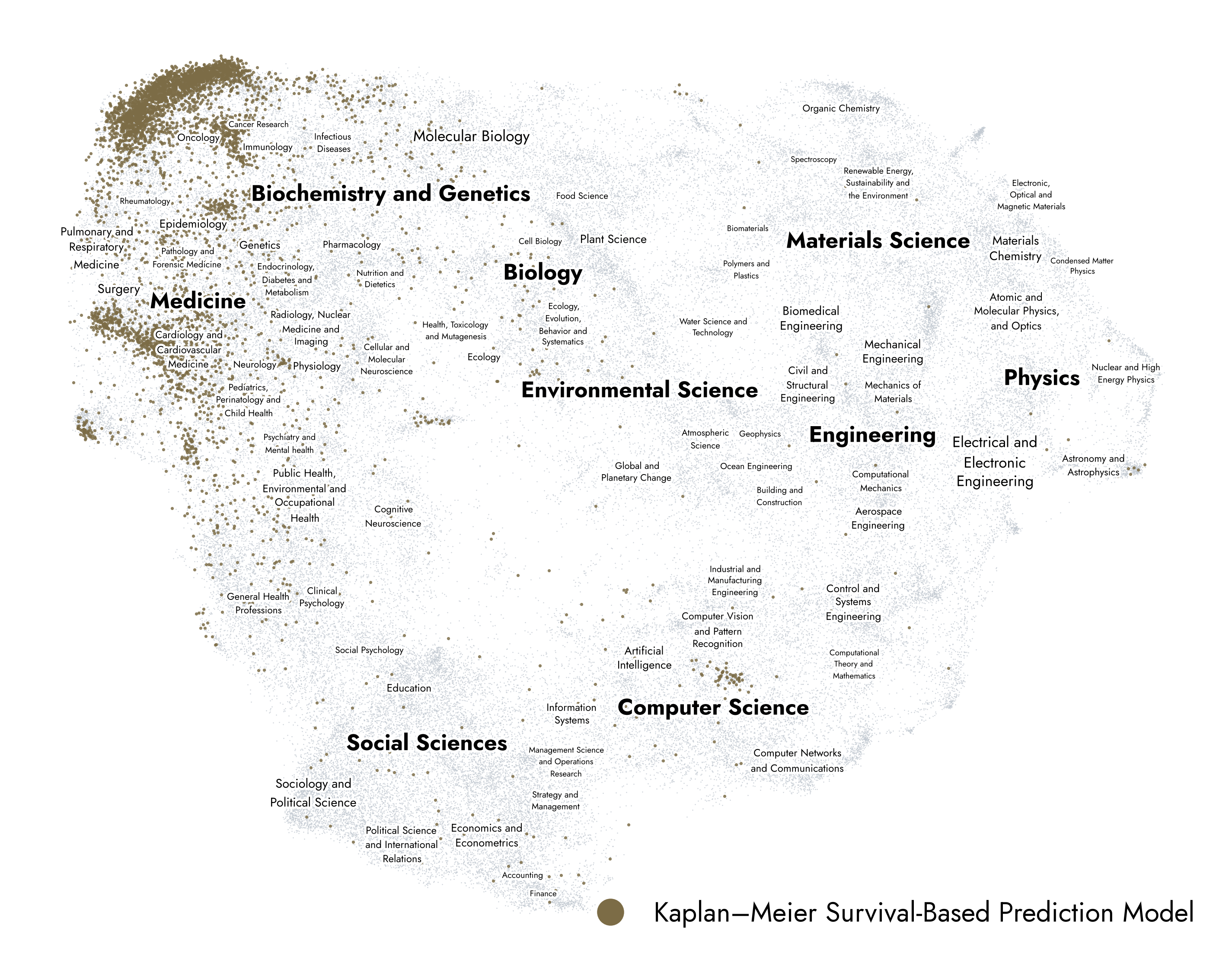
Kaplan–Meier survival model Model of survival processes. Concentrated in medicine & genomics.
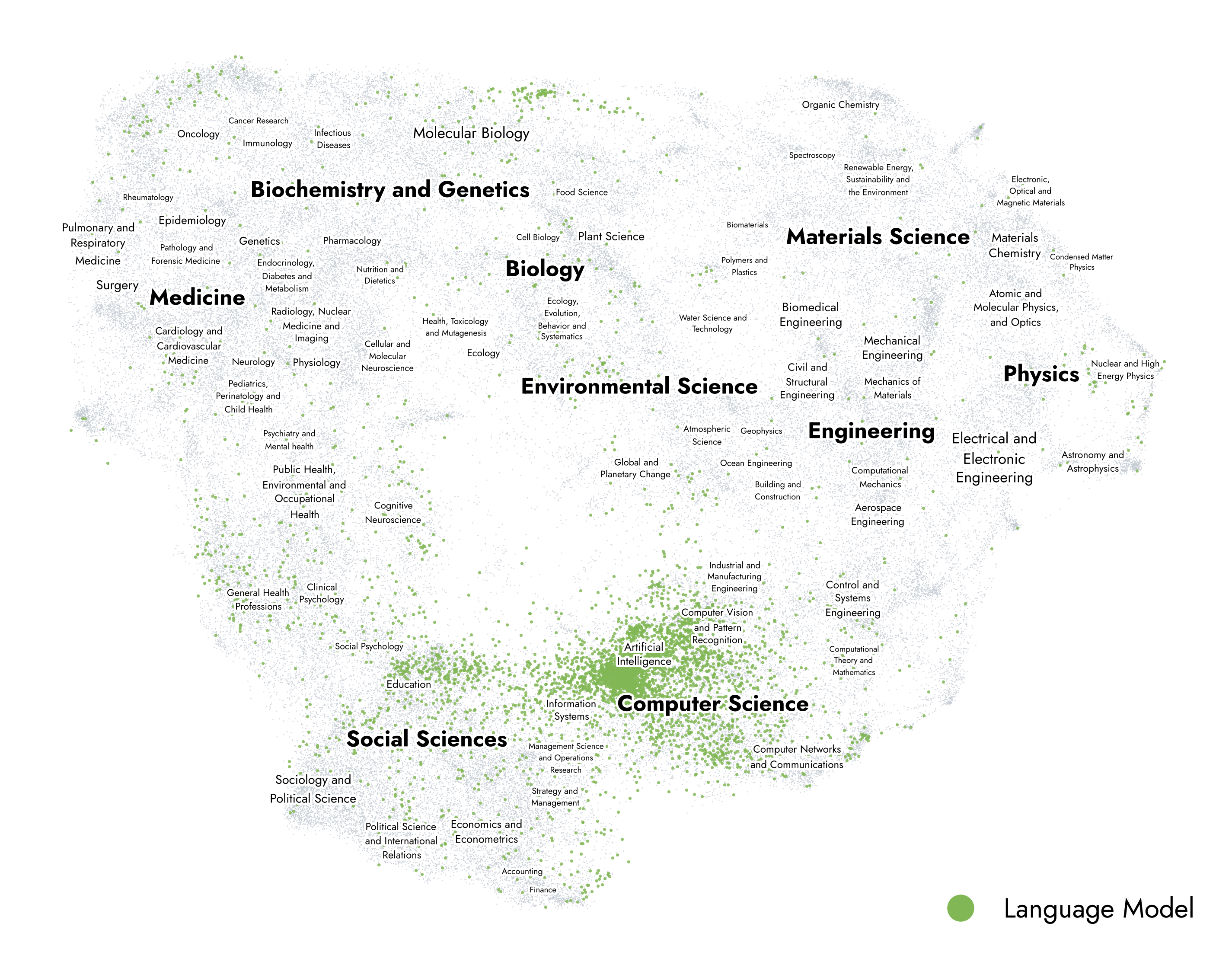
Language model Centred on computer science and AI, reaching into the social sciences and medicine.
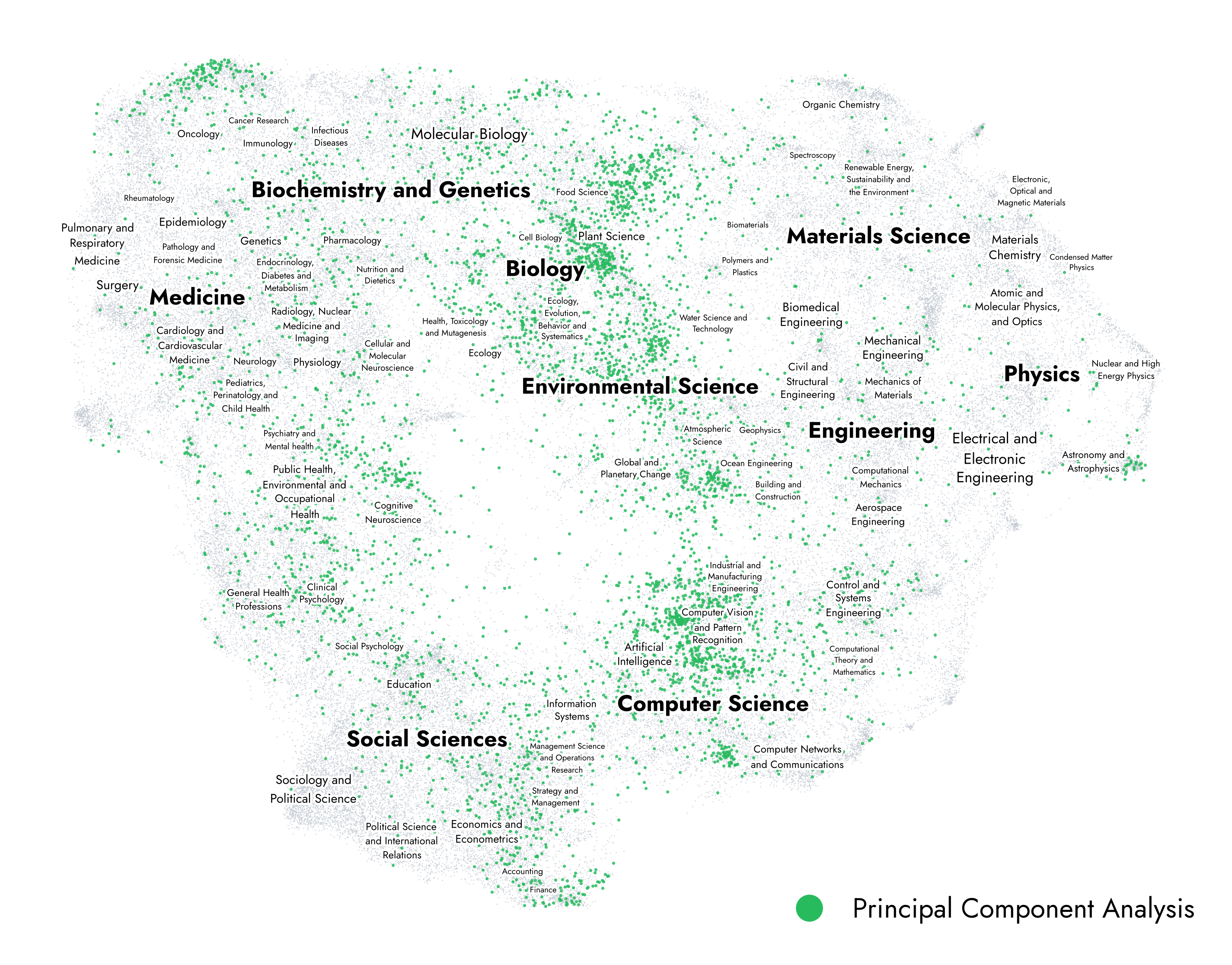
Principal component analysis Basically everywhere.

Part V
The structure of
model transfer

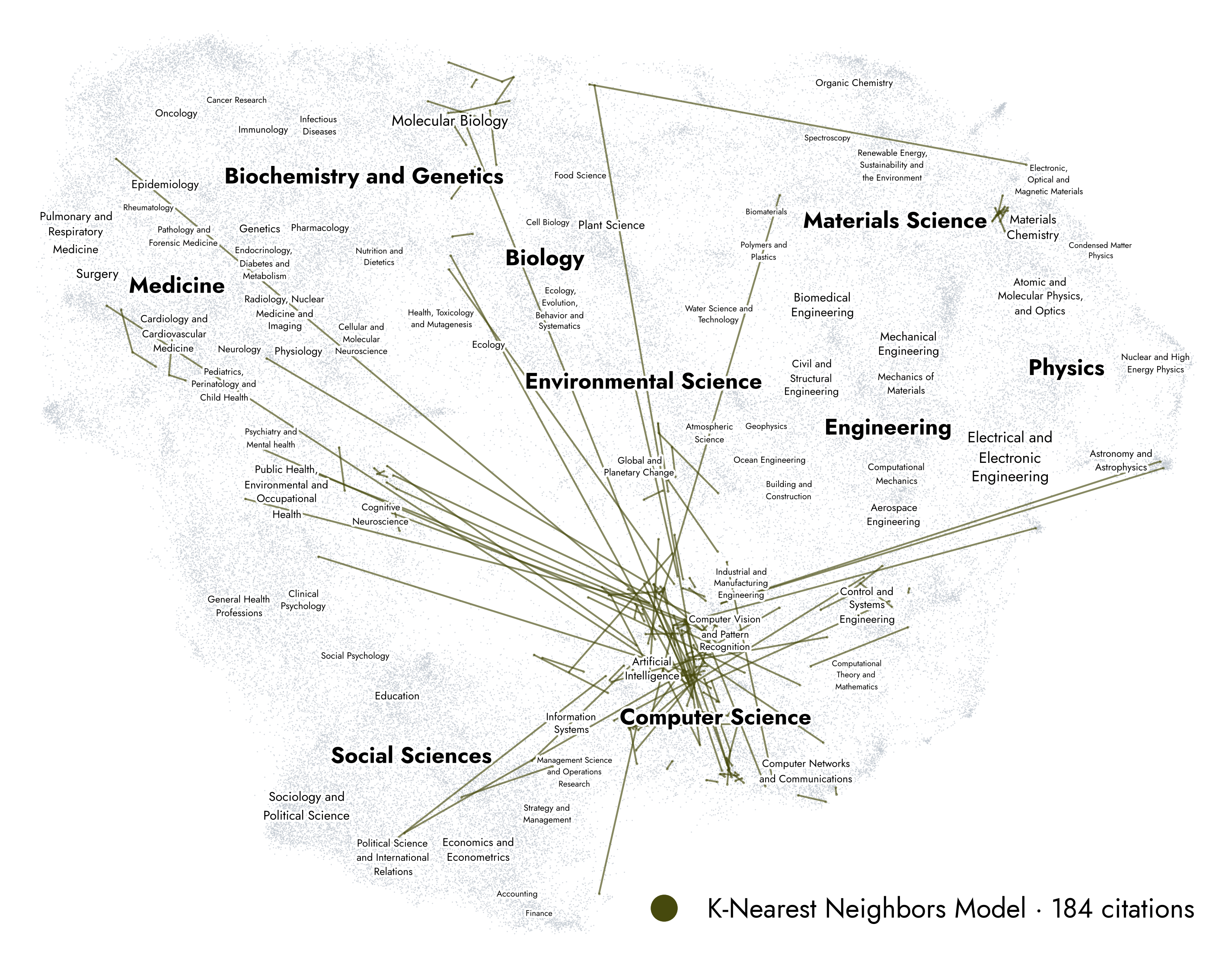
k-nearest neighbors Citations between the papers that use kNN graphs.
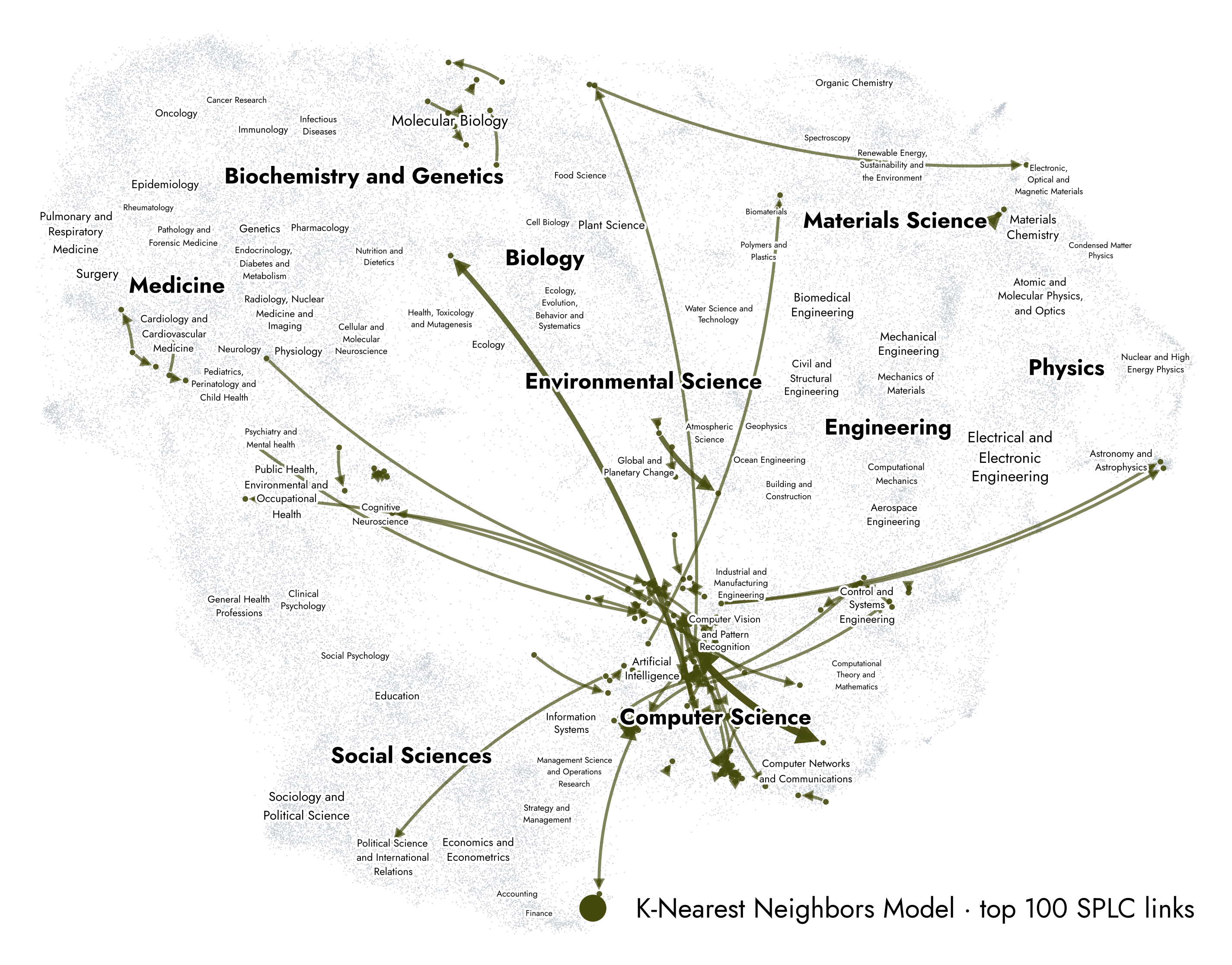
k-nearest neighbors Main path analysis: the paths most travelled through the citation graph (SPLC).
Hummon and Doreian (1989) Batagelj (2003)
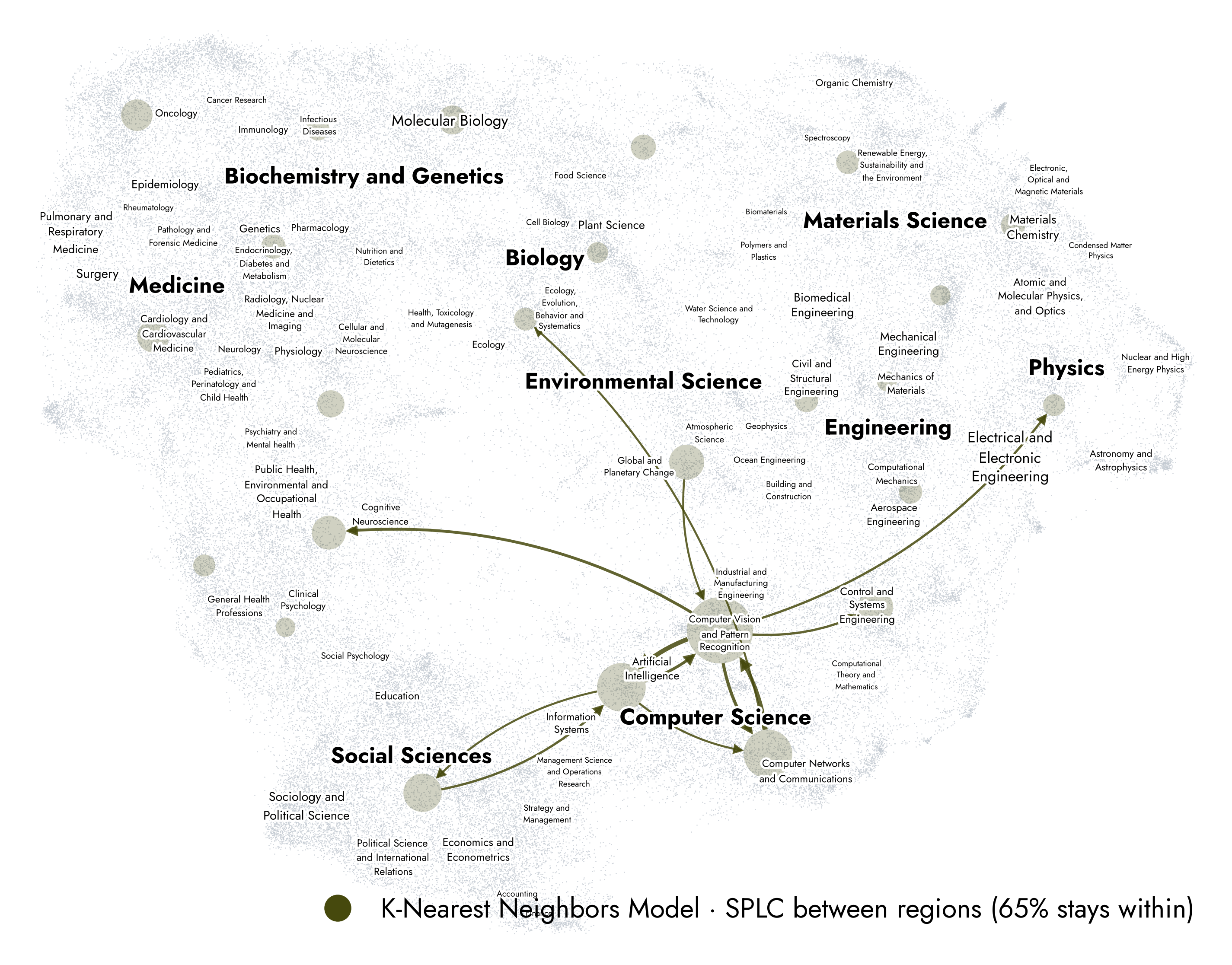
k-nearest neighbors SPLC aggregated by genieclust clusters: flow between regions of the map.
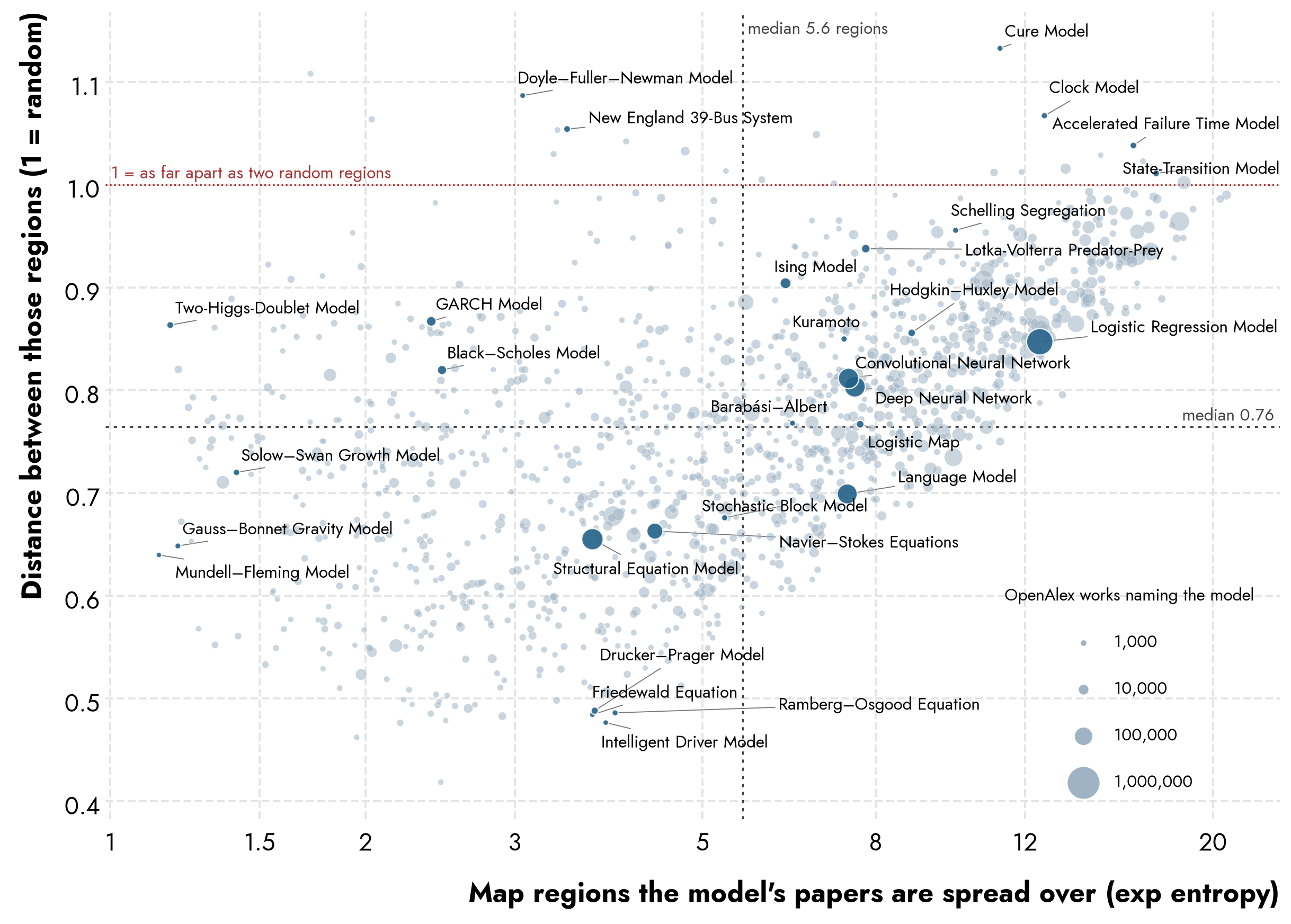
Spread How many map regions a model covers (x), and how far apart they are (y). Many models sit high on both.
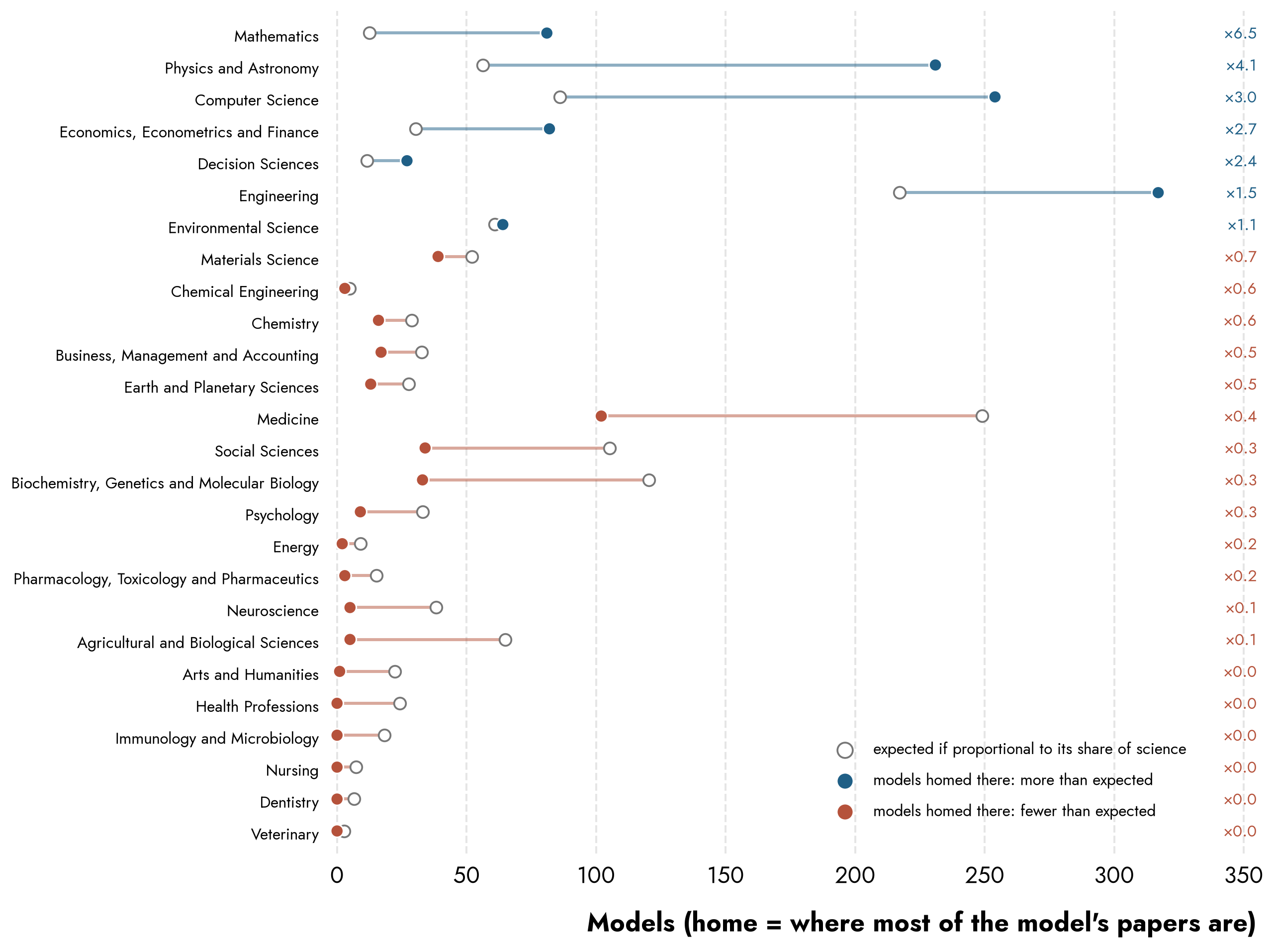
Homes Distribution of models across main nodes (mean share 52%).
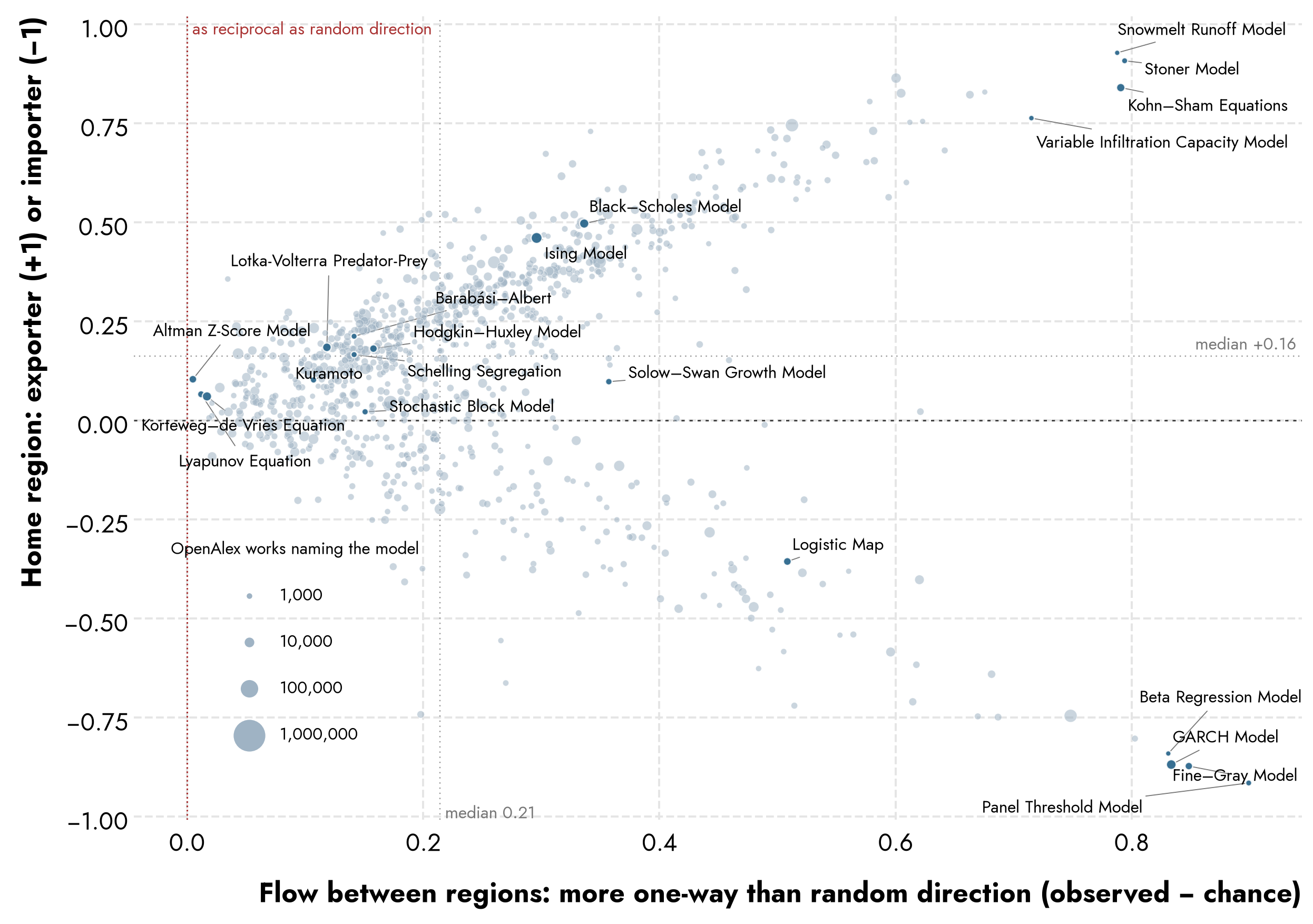
Symmetry How one-way a model’s flow between regions is (x), and whether its home region exports or imports it (y).

Summary of first results

  • Many models are local only, but a decent share travels widely.
  • There is no single centre of model origin: models arise in several centres, but not uniformly.
  • Flow between areas tends to be asymmetrical.

Some qualifications & further work

  • OpenAlex is not perfect.
  • We’re limited to sources that include abstracts (recency bias) and citations.
  • Undersampling of citations.
  • Expert review.
  • Various UMAP issues.

HAI101 · LSE · 6 November 2026

Thank you

maxnoichl.eu/talk

Literature

Andrews, Mel. 2023. “The Devil in the Data: Machine Learning & the Theory-Free Ideal.” Pre-published.
Batagelj, Vladimir. 2003. Efficient Algorithms for Citation Network Analysis. arXiv:cs/0309023. arXiv. https://doi.org/10.48550/arXiv.cs/0309023.
Breiman, Leo. 2001. “Statistical Modeling: The Two Cultures.” Statistical Science 16 (3): 199–215. http://www.jstor.org/stable/2676681.
Bzdok, Danilo, Naomi Altman, and Martin Krzywinski. 2018. “Statistics Versus Machine Learning.” Nature Methods 15 (4): 233–34. https://doi.org/10.1038/nmeth.4642.
De Bruin, Jonathan. (2022) 2023. PyAlex. V. 0.8. October 25, released March. https://github.com/J535D165/pyalex.
Herfeld, Catherine, and Chiara Lisciandra. 2019. “Knowledge Transfer and Its Contexts.” Studies in History and Philosophy of Science Part A 77: 1–10. https://doi.org/10.1016/j.shpsa.2019.06.002.
Houkes, Wybo, and Sjoerd D. Zwart. 2019. “Transfer and Templates in Scientific Modelling.” Studies in History and Philosophy of Science Part A 77: 93–100. https://doi.org/10.1016/j.shpsa.2017.11.003.
Hummon, Norman P., and Patrick Doreian. 1989. “Connectivity in a Citation Network: The Development of DNA Theory.” Social Networks 11 (1): 39–63. https://doi.org/10.1016/0378-8733(89)90017-8.
Humphreys, Paul. 2004. Extending Ourselves: Computational Science, Empiricism, and Scientific Method. Oxford University Press. https://books.google.com?id=ZIot7QGz7eEC.
Knuuttila, Tarja, and Andrea Loettgers. 2023. “Model Templates: Transdisciplinary Application and Entanglement.” Synthese 201 (6): 200. https://doi.org/10.1007/s11229-023-04178-3.
Malaterre, Christophe, Jean-François Chartier, and Francis Lareau. 2020. “The Recipes of Philosophy of Science: Characterizing the Semantic Structure of Corpora by Means of Topic Associative Rules.” Plos One 15 (11): e0242353.
McInnes, Leland, John Healy, and James Melville. 2018. “UMAP: Uniform Manifold Approximation and Projection for Dimension Reduction.” February 9. http://arxiv.org/abs/1802.03426.
Priem, Jason, Heather Piwowar, and Richard Orr. 2022. “OpenAlex: A Fully-Open Index of Scholarly Works, Authors, Venues, Institutions, and Concepts.” Pre-published June 17. https://doi.org/10.48550/arXiv.2205.01833.
Singh, Amanpreet, Mike D’Arcy, Arman Cohan, Doug Downey, and Sergey Feldman. 2023. “SciRepEval: A Multi-Format Benchmark for Scientific Document Representations.” Pre-published November 13. http://arxiv.org/abs/2211.13308.
Weingart, Scott B. 2015. “Finding the History and Philosophy of Science.” Erkenntnis 80 (1): 201–13. https://doi.org/10.1007/s10670-014-9621-1.
Zhang, Yanzhao, Mingxin Li, Dingkun Long, et al. 2025. Qwen3 Embedding: Advancing Text Embedding and Reranking Through Foundation Models. arXiv:2506.05176. arXiv. https://doi.org/10.48550/arXiv.2506.05176.
Zichert, Michael, and Adrian Wüthrich. 2024. “Tracing the Development of the Virtual Particle Concept Using Semantic Change Detection.” Pre-published October 22. https://doi.org/10.48550/arXiv.2410.16855.